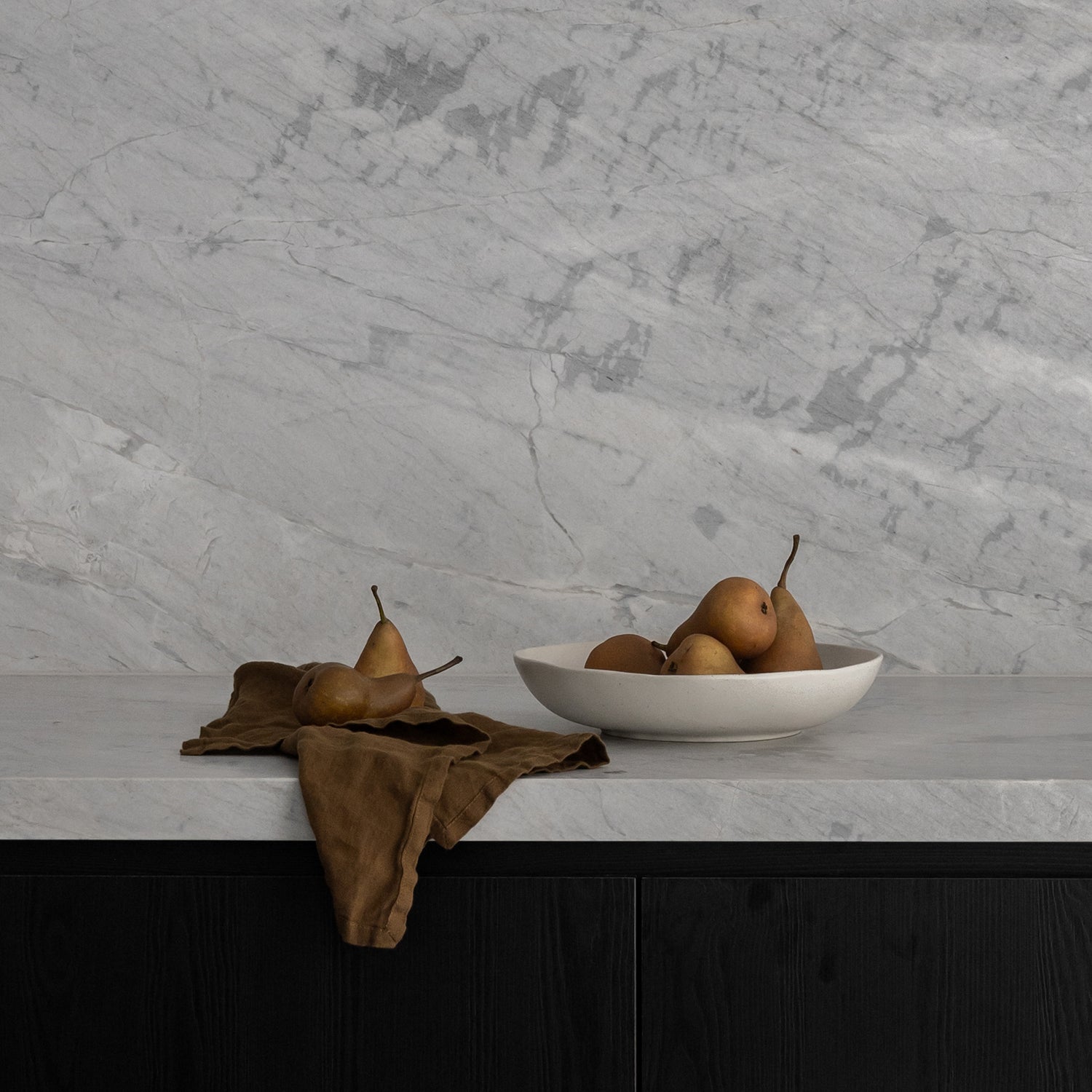
One Detail, Three Methods: How Stone-Clad Joinery Actually Gets Made
A stone-clad cabinet front can look identical in a render, a sample, and on the day it's installed, while being built three completely different ways underneath. That gap between how something looks and how it's actually constructed is exactly where cost, hardware and timing decisions get made, often without anyone realising a decision has been made at all.

Three ways to build the same front
When stone is applied to a cabinet door or drawer front, there isn't a single standard approach. Broadly, a joiner has three options:
Recess a joinery panel into the back of the stone. The stone door or drawer sits in front, and hinges and runners mount directly to the joinery panel behind it.
Direct-stick the stone to a joinery panel. Simple in principle, but it adds the full thickness of the stone on top of the panel thickness, which changes the overall door depth more than people expect.
Fully clad the joinery front. Stone covers the face and all four edges of the panel, wrapping it entirely. Hinges and runners still mount to the joinery panel underneath.
Each method starts from the same brief and produces a visually similar result. What changes is everything that isn't visible: thickness, weight, and how the door or drawer actually opens and closes.
Why the method has to be agreed before pricing
The construction method isn't a detail that can be resolved after the joinery is priced. It determines the fabrication, so it needs to be locked in first.
Drawer runners need enough weight capacity for the finished front, and a heavier stone-clad front may call for a different runner altogether. Thicker fronts affect hinge clearances, sometimes requiring 155-degree hinges or additional hinges to carry the extra weight properly. The method also shapes the opening detail itself, whether that's a shark-edge or square-edge shadowline, an overhanging front, push-to-open, or a Blum SERVODRIVE system.
There's also a knock-on effect for how the piece gets to site. Depending on the method, a mason may need split joinery for installation, templates taken from the joinery panels, or the finished doors and drawers delivered to the stone factory before final assembly. None of that is difficult to manage, but it does need to be identified early. Discovered late, it becomes extra handling, extra delivery, and extra cost that wasn't in the original scope.
The practical upshot
If a design brief calls for a stone-clad front, the useful question to ask isn't just "what will it look like?" It's "which method are we building it with?" The visible design can stay exactly the same across all three answers. The fabrication, hardware and sequencing behind it won't.
Getting the joiner and the mason to agree on method before final pricing is a small step that saves a lot of second-guessing later. It's the kind of detail that's invisible when it's handled well, and very visible when it isn't.