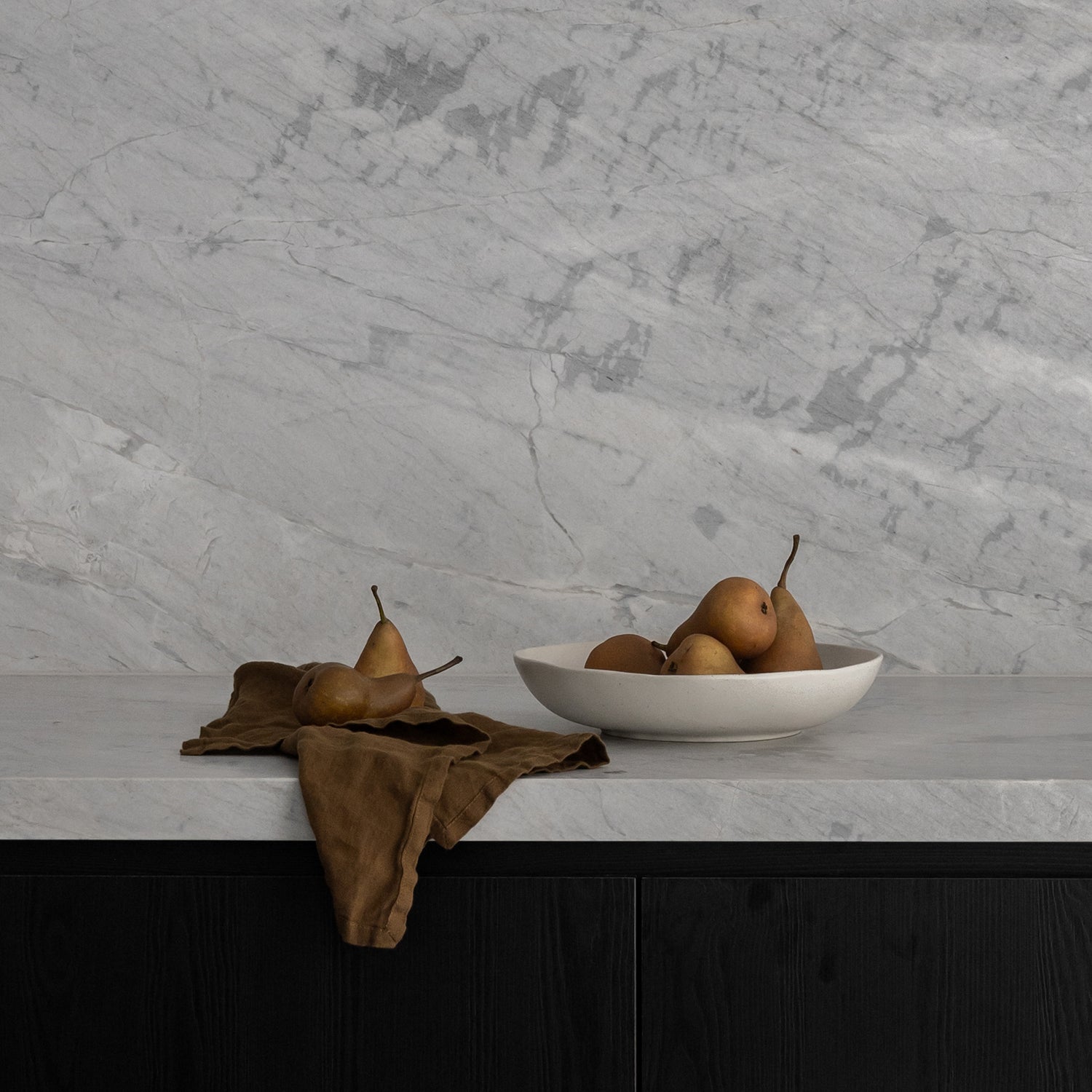
Solas Residence is defined by a confident material palette, where walnut joinery sits alongside expressive Calacatta Viola marble, softened by sculptural plaster forms. Within an interior that embraces a combination of curves and straight lines, the role of joinery becomes less about insertion and more about integration. Each element must respond precisely to its surrounding architecture, allowing the space to read as one continuous composition.
Much of traditional joinery is designed to sit within rectilinear environments, where walls, floors and ceilings provide clear reference points. At Solas Residence, those conventions are softened. Curved plaster walls, a sculptural stair and flowing transitions between spaces create a non-linear framework, where standard assumptions no longer apply.
In this context, joinery cannot simply be applied. It must be carefully resolved in relation to the architecture, with each junction considered in three dimensions. Alignment, proportion and tolerance become critical, particularly where curved surfaces meet fixed joinery elements.

Walnut joinery introduces warmth and depth, grounding the interior, while Calacatta Viola marble brings movement and contrast through its distinctive veining. Travertine further softens the palette, reinforcing a sense of continuity across surfaces. The success of the joinery lies in its ability to support these materials rather than compete with them. Profiles are refined, detailing is controlled, and transitions are resolved with care, allowing the stone to remain the focal point while the joinery provides structure and balance.
Projects such as Solas Residence rely on a close alignment between design ambition and technical execution. Where this relationship is carefully managed, the outcome feels effortless. Materials sit naturally within the space, transitions are clean, and the integrity of the design is preserved. Our role is to navigate that intersection, bringing a level of technical clarity that supports the architectural vision without diluting it.

The result is an interior that feels calm and cohesive, where curves, stone and joinery exist in quiet alignment. Light moves across sculptural surfaces, materials shift subtly throughout the day, and each element contributes to a broader sense of balance and restraint. Behind this outcome is a process of careful coordination and disciplined execution, ensuring that complex forms and expressive materials are realised with precision.